Friday, July 27, 2012

The West Village. Sui generis. What it costs to live there and what you get for the money.


The narrow, cobblestoned streets of the West Village are lined with rowhouses two hundred years old and shaded by the green canopies of ancient trees.   
West Village Street in winter (Wikipedia)
These streets wander at the will of the settlers who moved north of the original city to escape the cholera and yellow fever epidemics of the early 19th century.  Some of them wander at the will of the cows that grazed there even earlier.

The West Village is bounded on the east by 7th Avenue (some say 6th), on the west by the Hudson River, on the north by 14th Street and on the south by Houston or perhaps a few blocks below. What's between does not follow Manhattan’s grid.

Minetta Street, named for the brook that still runs under parts of it, makes an abrupt turn for no particular reason.  So does Gay Street.  4th and 11th Streets intersect.  Commerce Street has absolutely nothing to do with commerce.

No wonder it was home to the Bohemians, artists, poets, folksingers and others of earlier generations who rebelled against convention.
 
Once, when I was new to New York, after venturing only a few blocks into the West Village, I got so lost that I had to take a taxi to get back to my apartment on 12th Street.  It was years before I went back in there again without a map. 

The early 20th century Gothic horror writer H. P. Lovecraft wrote a bone-chilling story about an unfortunate who gets lost in the West Village late one night under a full moon (and apparently couldn’t get a taxi).  I will spare you the grisly details.*  But that was long, long ago, and besides, he made it up.

Today the shops along Bleecker Street are as chic and trendy as those in Soho or on upper Madison.   The historic townhouses are as pricey as are to be found anywhere in Manhattan.  A penthouse condo can cost upwards of $20,000,000.
Gay Street winds around a corner (Chester Higgins photo, NY Times)

But if you’re willing to make certain sacrifices, you can live there quite inexpensively.

If you don’t mind the climb, a fourth-floor walkup studio can be yours for under $350,000.  The average one bedroom apartment will cost you about $800,000, with maintenance of about $1100.

Not bad when you consider that the average one-bedroom in the Central Village just a few blocks east costs $880,000, and could run as high as nearly $3,000,000 if it has a garden and is on the Gold Coast (that would be Fifth Avenue or just off it). 

A two bedroom apartment in the West Village will cost an average of $2,750,000.  

If you want amenities such as a doorman, or if you want a condo, especially a prewar condo, you’ll pay more—about $1,500,000 for a one bedroom, $2,900,000 for a two bedroom. 

Until recently, there were three pre-eminent prewar doorman condos in the West Village, all built in the 1920s by the architectural firm of Bing & Bing.  They are 299 and 302 West 12th Streets and 45 Christopher Street. 
Map of old Greenwich Village. A section of Bernard Ratzer's map of New York and its suburbs, made in the Eighteenth Century, when Greenwich was more than two miles from the city. ("Greenwich Village" Anna Alice Chapin)

But this year, two other prewar buildings have converted to condominiums. 

130 West 12th Street was a residential building for the staff of Roosevelt Hospital. 

It is now, as per the website, “Forty-Two Boutique Residences-One to Four Bedrooms $1.395 Million to $12.850 Million.“   They came to market last November and the building is now sold out. 

The Abingdon, formerly a nursing home and now ten very large and very pricey condos, is also selling briskly.  The smallest measures 3263 square feet and is priced at $8,750,000. 

The largest, at 9615 square feet (or nearly a quarter of an acre) plus a substantial terrace, is $25,000,000.   These were first offered in early June, and five of the ten are now under contract.

Sorry. I was going to talk about how inexpensive it can be to live in the West Village.  Somehow I got sidetracked.  Back to reality.

If you don’t have $8,750,000 at the moment and would prefer to rent anyway, you can have one of a few—a very few—studios in walkup buildings for under $2,000. 

The average rent for a studio apartment is about $2,800.  For a one bedroom, the average is about $4,500, and for a two bedroom the average is about $7,900. 

Be aware that once you live in the West Village, you will find it difficult to live anywhere else.  As a broker, I have never been able to pry anyone out with a crowbar.

*Okay, I'll give you this much: "...a colossal, shapeless influx of inky substance starred with shining, malevolent eyes.....poured thickly, like a flood of oil bursting a rotten bulkhead, overturned a chair as it spread, and finally flowed under the table and across the room to where the blackened head...still glared at me." 

You gotta love Lovecraft. 

Saturday, July 7, 2012

Soho update: Will the artist certification requirement be eliminated? Well, a committee's working on it.


The Soho/Noho artist certification requirement wars continue.

As discussed here earlier (see http://www.withconfidence.blogspot.com/2011/06/should-soho-and-nohos-artist.html), the city passed a law in 1971 that requires at least one resident of every loft in Soho and Noho to be certified as a fine artist by the Department of Cultural Affairs.
The law also says that, without a special permit, commercial spaces must be for wholesale use only.
As nobody’s paid much attention to this law in the last fifteen to twenty years, there are those who think it should be eliminated. 
There are others who think it should stay. 
The problem is that the city does not have to give a certificate of occupancy to a building that doesn't comply with the artist certification requirement.  And there are many Soho buildings that don't have permanent certificates of occupancy.
Without a C of O, a co-op or condo can run into trouble when it wants permits from the city to do work on the building. 
Banks prefer not to lend in buildings that don't have a C of O.
Margaret Baisley, a real estate attorney who has long worked in Soho, is the chair of a committee that has raised $30,000 from Soho loft owners and is looking for a way to get rid of the certification requirement.

The Wall Street Journal reports that the money will be used to conduct a survey to determine how many certified artists still live in Soho and how many retail spaces are being occupied illegally. 

Baisley is in discussions with Baruch College’s Steven L. Newman Real Estate Institute, to begin conducting the survey later this month.

I have made numerous sales in Soho and Noho over the last 20 years.  I do not remember any of them being made to a certified artist. 

However, many were made to Wall Streeters who were attracted by the cachet of a neighborhood considered artistic and rather Bohemian.

As for the wholesale usage of commercial space, a quick walk through Soho leads one to believe that either there are a whole lot of special permits, or a whole lot of retailers are there illegally.  

There are the high-end retailers—Chanel, Prada, Coach and others who moved in when the Wall Streeters did.  And now there are two H & M stores within a couple of blocks of each other on Broadway plus numerous other bargain retail outlets. 

Whether you want a handbag for $3500 or a miniskirt with a lot of sequins for $25, Soho's where you go.  There's one whole store with nothing but Crocs.  Soho is retail heaven.

The artist certification requirement has always been controversial.  There are those who doubt its constitutionality.  And it’s somewhat whimsical.  Certification is only given to “fine” artists, that is, painters, poets and choreographers, not to “interpretive” artists such as actors, musicians and dancers. 

Why a poet would require a huge loft to write in is beyond me; Wallace Stevens wrote some of the 20th century’s greatest poetry on the sidewalks of Hartford while walking to work. 

Paloma Barrara, on the other hand, doesn’t need loft space, according to the DCA.  She can perform grand jetes and pirouettes in a closet for all they care.

The anti-elimination faction feels the character of Soho will change drastically if the requirement is eliminated.  Personally I question their use of the future tense. 

If they think it hasn't already changed drastically from what it was when they bought their lofts, they must never come out of them.

I will follow this committee’s efforts with great interest.

Monday, June 11, 2012

Does your dog like blueberry facials? Yes, there are condo buildings that offer them.


The Wall Street Journal reports that later this summer, 20 buildings in New York will offer dog services via a partnership with the Spot Experience, a dog services provider. 

For a $500 annual membership fee, if you live in any of these buildings your dog will get 10 emergency walks, 24-hour access to the facilities, pickup and drop-off, home training and various other things including anesthesia-free dental work. 

Some buildings already offer pet services.  Dog groups say there are 1,400,000 dogs in New York and developers figure they've all got to live some place.  Take that, dog-free co-ops!

The Journal tells us that, ”On a recent evening, Dee Maxfield faced a situation dreaded by dog-owners across the city. The 35-year-old mother was at home, her six-week-old daughter had just fallen asleep and her husband called to say he was running late and couldn't pick up their dog from the day-care center.

“But instead of panicking, she picked up the phone and called downstairs. Two minutes later, Paisley, the couple's labradoodle, stood at the door—complete with a report card detailing her day, and glowing from an earlier bath, full brush-out and blueberry facial.*
“That is because the dog spa and day-care center, Wag Club, was located on the first floor of her Brooklyn apartment building, One Brooklyn Bridge Park. ‘The convenience is paramount,’ Ms. Maxfield said. ‘It's great.’”
Anesthesia-free dental work doesn’t sound like much fun for the dog, but there are risks with anesthesia.  One of my dearest friends, a long-haired German Shepherd named M’Liss, died of over-anesthesia while being treated for a broken leg, a huge loss to me and her owners.
However, M’Liss would have turned up her pedigreed nose at a blueberry facial.  She was beautiful just the way she was.
Here’s the link:  http://online.wsj.com/article/SB10001424052702303753904577454780835071746.html

 *Yeah, I didn't know either, so I googled.  Turns out a blueberry facial is, according to www.dogtime.com®, an "All-natural SPA™ Fresh Facial Scrub [that] pampers pets with beauty-enhancing, botanical formulas. Gentle formula contains vanilla and blueberry to remove stains without irritating eyes or sensitive skin."  The site doesn't say anything about paraffin wraps.

Saturday, June 9, 2012

A brief vocabulary lesson from a real-estate pedant.

You, Gentle Reader, are way too smart to call a townhouse a "townhome."  Or call a brick house a brownstone.  Or confuse a mere top floor with a penthouse, or a balcony with a terrace, or a new apartment with a loft. 

But if you know someone who does make these errors, please pass the following along to him.

First of all, anything in that's in a town and that somebody calls home is a town home, from the $88 million penthouse at 15 Central Park West to, unfortunately, a refrigerator carton under the George Washington Bridge.

However, some developers use “townhome” to mean a maisonette that is part of a new apartment building.  

(A maisonette is a one- or often two-story apartment at the bottom of a building.  It  has an entrance from the lobby but usually also has its own separate entrance from the street.  In other countries, it is simply a two-story apartment with internal stairs; it's what we would call a duplex.)

Some brokers have also begun to use “townhome” as another name for a townhouse.

They think “townhome” sounds more elegant.  It doesn’t.  It sounds inaccurate and pretentious.  The only acceptable terms for a house in town are townhouse, rowhouse (that is, a house that shares walls with the houses on either side of it), or house. 

Unless, of course, the house in question is a brownstone. 

A brownstone is a townhouse that is faced with brown stone.  A brick townhouse is not a brownstone.
447 West 24th Street - Stribling & Associates
A brick townhouse.  If it's made of brick, it's a brick townhouse
or rowhouse, or simply a house.
Sure, there are those who use “brownstone” and "townhouse” interchangeably.  There are also those who say, “between you and I,” but that doesn’t make it acceptable.  
833 President St - Stribling & Associates
A brownstone. If it's not brown, it's not a brownstone.
A few more definitions: 

A penthouse is a small house built on the roof of a building.  It is surrounded by terrace, usually on at least three sides. 

Brokers will sometimes describe the top floor of a loft building as a “penthouse.” 

But the top floor of a building is not always a penthouse.  Even if the owners of the top floor have exclusive rights to the roof, the top floor is not a penthouse.  A penthouse has outdoor space that you don't have to climb stairs to get to. 

A terrace is a setback, large or small, near the top of a building.  The floor of a terrace is the roof of the floor below.  

A terrace.
A balcony is outdoor space that has air under it.  This kind of outdoor space is always a balcony, never a terrace, no matter how big it is.

A balcony. 
A loft is an apartment in a building that was once a factory or a warehouse.  All lofts are pre-war.  Apartments in new buildings are not lofts, even if they are huge and have open kitchens and 10’ ceilings. 

And that concludes my rant for today.

Friday, June 8, 2012

Now is a great time to sell a condo. To buy one, not so much.

Sellers now officially control the market for condos in Manhattan.

As per the Streeteasy May market report, it will take just 5.8 months to sell the inventory of condos currently available. 

The rule of thumb is, more than nine months of inventory is a buyers' market.  Six to nine months is a balanced market.  Less than six months is a sellers' market.

And don't forget, that 5.8 months of inventory includes condos with brick wall views, condos with huge monthly costs, condos that are wildly overpriced and have been sitting on the market forever, and condos with other fatal flaws which mean you don't want them anyway. 

The desirable condos are few and far between, and are getting snapped up the minute they become available.

So if you need a place to live in a hurry, these are your options:  tell your broker to keep her/his eyes peeled and let you know the SECOND something desirable becomes available, check out co-ops (depending on your needs, they may be a better option anyway--e-mail me at cstimpson@stribling.com to discuss) or start looking at rentals. 

Here's the link:  http://docs.streeteasy.com/monthly_market_report/2012-05-monthly-market-report.pdf

Wednesday, June 6, 2012

More about NYC's tallest-residential-building-to-be.

432 Park Avenue,. still in the planning stage, will tower over everything else in its neighborhood and most of everything in New York at 1300'. 

Of course, we're talking residential. 

The Liberty Tower, at approximately 1776',  will still be substantially taller.  Just for comparison,  the Empire State Building  is 1250' tall if you don't count the lightning rod, and 1454' if you do.

The world's very tallest building, however, dwarfs everything in New York.  It's the Burj Khalifa, it's in Dubai, and it's 2716' feet tall.  That's more than half a mile. 

Here's the link to a Wall Street Journal article about 432 Park  http://blogs.wsj.com/developments/2012/05/29/details-revealed-for-super-tall-tower-in-new-york/?KEYWORDS=432+Park+Avenue

Wednesday, May 30, 2012

Downtown co-op lofts: no dog spas, but many can be had for under $1,000 per square foot.

As I’ve discussed earlier, there is a much greater difference between co-ops and condos downtown than there is in the rest of Manhattan.  At least on the inside.

Anywhere else in Manhattan, if you want to know if an apartment is a co-op or a condo, you have to ask somebody.

In Soho, Noho and Nolita, it's pretty obvious.  Nearly all the condos in these neighborhoods are either new conversions that retain their original facades but are completely gutted and reconstructed on the inside, or newly constructed from the ground up. 

The co-ops are a different matter.  They’re real artists’ lofts which were factories and warehouses made habitable by the pioneer artists who settled there forty or fifty years ago.

Because the condos are new and shiny and have such weird amenities (weird to the pioneers, at least) as doormen and exercise rooms and wine cellars and dog spas, their prices are much higher. 

Another reason for condos’ higher prices is their current popularity.  Suddenly, everybody wants a condo.  And there are far fewer condos than co-ops.  (A good case can be made for either, depending on your needs, but that’s a subject for another time.)

For the last twelve months, the average price per square foot for a co-op loft in Soho, Noho and Nolita has been $1,047, as opposed to about $1,750 for a condo.

The highest PPSF for a co-op loft was $1,623 for a 2400 s.f. high full floor at 458 Broadway, with 2.5 baths, in mint condition, with 24 windows spread along both a long wall and a short wall.

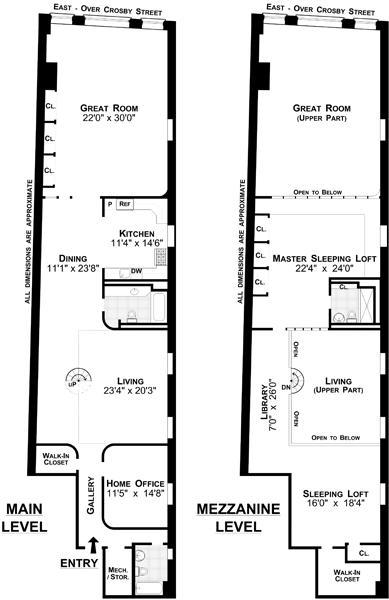
The lowest PPSF, $521, was for a second floor loft at 620 Broadway that faced east over Crosby Street. 

The foot print of the 620 Broadway loft is about 2400 square feet, but the typically high (15 feet in this case) ceilings of a second floor allow for another 700 square feet or so of mezzanine which brings the total square footage up to the listed 3146.  I didn’t see this one, but the condition was given as excellent.  

It's a gray area as to whether mezzanine square footage should be counted as the ceilings in the mezzanine areas are lower than the 8' required by the Department of Buildings, so the price per square foot here may be artificially reduced. 

The lack of light here would be a problem for many buyers.  Note that the indentations on the south wall are not windows. 

They used to be lot line windows--that is, windows in a wall that sits on the very edge of the lot--that looked over a gas station, but the gas station gave way to a big glass-curtain-walled commercial building with a huge Adidas store on the ground floor, and the windows are no more.  Thus the perils of lot-line windows.


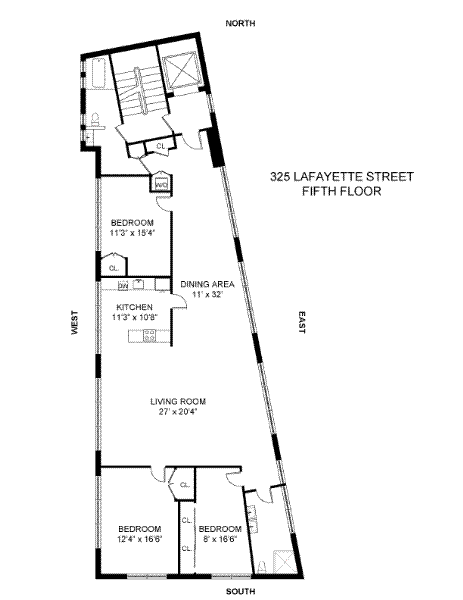
The median price was $1,160, for a 2000 s.f. fifth floor loft at 325 Lafayette Street.  This was an extremely odd shape for a loft; it’s a trapezoid, and very narrow at one end.  It needed a complete gut renovation.

The clients I showed it to were put off by the configuration,  but it gets a huge amount of light and has windows on all sides except the really short wall where the elevator and the stairs are.  

Another huge advantage of this loft is that the maintenance is basically cab fare--$600 a month.  The building has no underlying mortgage, and the tenant share-holders derive income from the commercial space on the ground floor.


Here’s the spreadsheet:


SOHO NOHO NOLITA CLOSED CO-OP SALES, $1,000,000+  MAY 2011--MAY 2012
ADDRESSAPT SFS&C PRICE$PSFCLOSEDMAINT ENANCE
458 Broadway72387$3,875,000 $1,6233/7/12$2,800
117 Prince 3C2300$3,100,000 $1,3483/22/12$2,200
48 Great Jones 3F2303$3,100,000 $1,3464/5/12$2,250
458 Broadway4FL2387$3,200,000 $1,3411/5/12$2,800
682 Broadway3FL3000$4,000,000 $1,3338/25/11$4,270
45 Crosby 6N1955$2,600,000 $1,33011/22/11$1,850
114 Spring41581$2,100,000 $1,3286/29/11$2,500
114 Spring 3FLR1662$2,200,000 $1,3243/19/12$2,500
477 Broome 431111$1,430,000 $1,2879/14/11$1,686
541 Broadway4B3200$4,100,000 $1,2815/23/11$200
292 Lafayette 7W1433$1,820,000 $1,2701/11/12$2,235
66 Crosby 4B1540$1,950,000 $1,2661/10/12$1,593
45 Crosby 4N1955$2,475,000 $1,2668/19/11$1,850
22 Wooster 4C3000$3,750,000 $1,2508/5/11$3,911
652 Broadway7R1500$1,850,000 $1,2331/13/12$603
431 W. Broadway4FL2000$2,375,000 $1,1887/21/11$1,300
27 Howard4TH2000$2,325,000 $1,1637/28/11$3,100
325 Lafayette5FL2000$2,320,000 $1,1604/21/12$600
135 Greene 5S2600$2,950,000 $1,1357/19/11$2,100
424 Broome52200$2,449,000 $1,1135/25/11$1,680
468 W.Broadway5D1571$1,700,000 $1,0824/18/12$2,005
101 Wooster 3F1951$2,060,000 $1,0568/10/11$2,094
712 Broadway22600$2,700,000 $1,0387/14/11$3,622
543 Broadway42148$2,225,000 $1,0364/4/12$0
113 Princ Street5ER1350$1,390,000 $1,0308/18/11$1,333
307 W. Broadway7FL3200$3,175,000 $9924/23/12$1,650
16 Crosby 3RN2200$2,180,000 $9918/30/11$83
135 Greene 4S2650$2,625,000 $9915/23/12$2,100
114 Mercer4R2250$2,225,000 $9894/13/12$2,810
242 Lafayette 4S1480$1,412,500 $9541/5/12$2,215
561 Broadway5A2100$2,000,000 $95212/14/11$3,400
16 Crosby2F2722$2,375,000 $87310/28/11$67
565 Broadway34184$3,600,000 $8601/26/12$6,834
45 Crosby 5N1955$1,625,000 $8314/26/12$1,850
141 Wooster 3C1760$1,453,000 $82610/11/11$2,100
81 Grand3FLR1575$1,200,000 $7621/19/12$2,000
307 W. Broadway6FL3300$2,450,000 $7425/15/12$1,500
182 Grand 2E2000$1,420,000 $7106/30/11$1,897
48 Great Jones 2NDFL4400$3,100,000 $7055/17/12$4,500
710 Broadway6TH2283$1,540,000 $6753/21/12$3,057
712 Broadway3RD2400$1,600,000 $66711/16/11$3,622
100 Wooster5TH2875$1,800,000 $6267/11/11$3,000
55 Great Jones3RD2100$1,250,000 $5951/5/12$0
620 Broadway2R3146$1,637,500 $52111/19/11$2,317
AVERAGE$1,047

 
See related link    http://withconfidence.blogspot.com/2011/12/what-are-best-co-ops-in-soho.html